Monday, 17 February 2025

Why Financial Planning Is More Important Than Ever in 2025

 

Why Financial Planning Is More Important Than Ever in 2025

3 January 20253 min read
Why Financial Planning Is More Important Than Ever in 2025

The financial world in 2025 is more dynamic and unpredictable than ever. Rapid technological advancements, shifting global economies, and changing societal priorities have created both challenges and opportunities. What was once considered a task for the future or a luxury for the few has now become a necessity for anyone aiming to build a secure and prosperous life. Financial planning for 2025 is no longer just about saving for retirement—it’s about navigating the complexities of modern life with confidence and clarity. Here’s why it matters so much today.

1. Economic Uncertainty and Inflation

The global economy continues to face uncertainty, with inflation rates fluctuating and the cost of living on the rise in many parts of the world. Essentials like housing, healthcare, and education have seen significant price hikes, making it crucial for individuals to have a robust financial plan. Strategic budgeting, investing, and saving can help combat the effects of inflation and safeguard one’s purchasing power over time.

2. Technological Advancements in Finance

The proliferation of financial technologies (fintech) has democratised access to financial tools and platforms. While this creates opportunities for better money management, it also introduces complexity and potential risks. A well-thought-out financial plan could ensure that individuals leverage these technologies wisely, avoiding pitfalls or falling victim to cyber scams.

3. Changing Job Markets and Career Paths

The job market in 2025 is marked by significant transformations, with automation, artificial intelligence, and the gig economy reshaping traditional career trajectories. Many individuals are pursuing freelance or entrepreneurial ventures, which come with irregular incomes and limited benefits. Financial planning helps mitigate these uncertainties, providing a safety net and guiding long-term wealth accumulation even in non-traditional employment scenarios.

4. Preparing for the Unexpected

If recent years have taught us anything, it’s the importance of being prepared for unexpected events. Natural disasters, pandemics, and geopolitical tensions can disrupt financial stability overnight. A comprehensive financial plan that includes emergency savings, insurance coverage, and diversified investments acts as a buffer against such uncertainties.

5. Generational Wealth and Legacy Planning

With a significant wealth transfer underway as Baby Boomers pass on their assets to younger generations, financial planning is crucial for managing inheritances responsibly. Moreover, individuals are increasingly focusing on creating a lasting legacy, which requires thoughtful will creation, estate planning, tax strategies, and philanthropic endeavours.

6. Personalised Life Goals

The aspirations of individuals have become more diverse, ranging from early retirement and global travel to pursuing higher education or supporting family businesses. Financial planning helps tailor strategies to unique goals, balancing short-term desires with long-term needs.

How to Start Your Journey  for Financial Planning 2025

If you haven’t already, 2025 is the perfect year to begin or refine your financial planning. Here are some steps to get started:

  1. Assess Your Current Financial Situation: Take stock of your income, expenses, assets, and liabilities.
  2. Set Clear Goals: Define your short-term, medium-term, and long-term objectives.
  3. Create a Budget: Allocate your income effectively, prioritising savings and investments.
  4. Invest Wisely: Diversify your portfolio to include a mix of equities, bonds, real estate, and alternative investments.
  5. Seek Professional Guidance: A certified financial planner can provide valuable insights and personalised strategies.

Also read: Don’t Start 2025 Without Answering These 5 Financial Questions

Conclusion

Financial planning for 2025 is no longer a choice but a necessity. It’s a tool that empowers individuals to navigate the complexities of modern life with confidence and clarity. By prioritising financial planning, you’re not just securing your future—you’re taking control of your present. Now is the time to act, plan, and ensure a financially resilient tomorrow.

Please note,

The views in the article /blog are personal and that of the author. The idea is to create awareness and not intended to provide any product recommendations.


What are the Pros and Cons of Loan Refinancing?


What are the Pros and Cons of Loan Refinancing?

25 September 20238 min read
What are the Pros and Cons of Loan Refinancing?

In a nation on the cusp of significant economic expansion like India, learning the art of loan refinancing can be a cornerstone for individual borrowers aspiring to build long-term wealth. The Reserve Bank of India (RBI) frequently adjusts the repo rate, which in turn influences the interest rates offered by commercial banks. These adjustments can be a double-edged sword. On one hand, a reduced repo rate can offer borrowers an opportunity to refinance existing loans at a lower interest rate, potentially saving thousands of rupees over the loan’s tenure. On the other hand, an increased repo rate could mean higher interest rates, prompting borrowers to reconsider their financial strategies.

But why does this matter to you? Whether you’re looking to reduce your monthly home loan EMIs or searching for better loan terms, understanding the nuances of loan refinancing in the context of repo rate changes can be a game-changer. Let’s dive deeper into what loan refinancing entails and how it could be a strategic move.

What is Loan Refinancing

Loan refinancing is a financial strategy that involves replacing an existing loan or multiple loans with a new loan that offers more favourable terms. The primary objective of refinancing is to obtain a lower interest rate, thereby reducing the overall cost of borrowing. However, the benefits of refinancing extend beyond just interest rate reduction; it can also provide a pathway to better loan management, financial flexibility, and long-term savings.

When you refinance a loan, you essentially take out a new loan to pay off the existing one(s). The new loan will have its own set of terms and conditions, ideally more advantageous than the original loan(s). These terms can include a lower interest rate, a different loan duration, or even a change in the type of interest rate (from variable to fixed, for example).

Retail Refinancing

A retail borrower may opt for refinancing when the interest rates fall or his ability to repay higher amounts whereby he can foreclose is possible. Every change in the interest rate may not be seen as an opportunity to refinance. Because each time there is an expense involved and this expense needs to be calculated/accounted for. Similarly, there is no guarantee that the individual’s request for refinance is going to be accepted by the lender. The reasons for rejection can be many: income levels, ability to continue to service, poor credit profile, etc. The borrower should ensure that all his mortgage papers are intact and are returned to him in the original state. Loan closure letters and updates in the credit bureau should be ensured. It is equally important for the borrower to ensure all his mortgage papers are updated and rightly listed by the new lender.

Types of Loan Refinancing

Rate-and-Term Refinancing

Rate-and-term refinancing is the quintessential form of refinancing that most people are familiar with. It provides you with the flexibility to modify either the interest rate, the loan term, or both. Essentially, you’re swapping out your existing loan for a new one, but the principal amount remains the same.

Why Consider It:

Lower Interest Rates: If market conditions have changed favourably since you first took out your loan, or if your creditworthiness has improved, you stand a good chance of securing a lower interest rate. This can result in significant savings over the life of the loan.
Adjustable Loan Terms: Life is unpredictable, and your financial situation today may not be the same a few years down the line. Rate-and-term refinancing allows you to extend or shorten the loan term to better suit your current financial standing and future goals.
Monthly Payment Flexibility: By altering the loan term or interest rate, you can also adjust your monthly payments to a level that’s more manageable for you.

Key Considerations:

Closing Costs: Refinancing isn’t free. You’ll need to account for closing costs, which can eat into your savings.
Loan-to-Value Ratio: Lenders will assess the value of your collateral against the loan amount. A favourable loan-to-value ratio can make you a more attractive candidate for refinancing.

Consolidation Refinancing

Consolidation refinancing is a strategic financial move that involves merging multiple existing loans into a single new loan. The new loan often comes with a lower average interest rate, making it easier to manage.

Why Consider It:

Simplified Financial Management: Juggling multiple loans can be a logistical nightmare. Consolidation refinancing streamlines your debts into one monthly payment, making it easier to keep track of your financial obligations.
Lower Overall Interest Burden: If your existing loans have varying interest rates, some of which may be quite high, consolidating them can result in a lower average interest rate. This can translate to lower monthly payments and less interest paid over the life of the loan.
Flexible Repayment Terms: Consolidation refinancing often comes with the option to choose a new repayment term, allowing you to tailor your financial commitments to your current situation and plans.

Key Considerations:

Prepayment Penalties: Some loans have penalties for paying them off early. Make sure to factor these into your calculations when considering consolidation.
New Loan Terms: While consolidating may lower your interest rate, it could extend your repayment period, which might result in you paying more interest over the long term.

Now that we’ve explored the different types of loan refinancing options available, it’s crucial to weigh their advantages and disadvantages. Each type comes with its own set of benefits and potential pitfalls, and the right choice for you will depend on your unique financial circumstances and objectives. As we transition into the next section, we’ll delve into the pros and cons of loan refinancing, equipping you with the knowledge you need to make an informed decision.

Pros and Cons of Loan Refinancing


pros and cons

Pros:

  1. Lower Monthly Payments: One of the most immediate benefits of refinancing is the potential reduction in monthly payments. This is achieved either by securing a lower interest rate or extending the loan term. The extra cash flow can be a financial lifesaver, allowing you to allocate funds to other pressing needs like emergency savings, investments, or debt reduction.
  2. Interest Rate Savings: Lowering the interest rate through refinancing can lead to significant long-term financial benefits. Even a modest reduction of 0.5% to 1% in the interest rate can translate into thousands of rupees or even more saved over the life of the loan, especially in the case of large loans like mortgages.
  3. Flexible Loan Terms: Refinancing offers the flexibility to adjust the loan term to better align with your current financial situation and future goals. Whether you’ve received a salary increase and wish to pay off the loan more quickly, or you’re facing financial constraints and need to extend the loan term, refinancing provides that latitude
  4. Simplified Payments: For those juggling multiple loans, consolidation refinancing is a godsend. It combines various loans into a single new loan with one monthly payment, thereby simplifying your financial management. This reduces the administrative burden and minimises the risk of missing a payment due to oversight.
  5. Improved Credit Profile: Timely loan repayments post-refinancing can positively impact your credit score. A higher credit score can make you more attractive to lenders, potentially leading to better terms on future loans or credit lines.
  6. Psychological Relief: Managing multiple loans with varying interest rates and due dates can be mentally taxing. Consolidation refinancing simplifies your financial landscape, providing psychological relief and freeing mental bandwidth to focus on broader financial planning.

Cons:

  1. Closing Costs and Fees: Refinancing is not without its costs. Fees can include application charges, origination fees, and sometimes appraisal and notary fees. These costs can range from 0.5% to 5% of the loan amount and must be carefully considered against the potential savings from refinancing.
  2. Longer Repayment Period: While extending the loan term will reduce your monthly payments, it also means you’ll be paying interest for a longer period. This can result in a higher total interest cost over the life of the loan, potentially offsetting the benefits of a lower monthly payment.
  3. Loss of Special Loan Features: Original loans may have features like grace periods, deferment options, or even cash-back rewards. Refinancing typically replaces the original loan with a more standard product, causing you to lose these special features.
  4. Prepayment Penalties: Some original loans have clauses that penalise you for paying off the loan early. These penalties can be a fixed amount or a percentage of the remaining loan balance. It’s crucial to factor these penalties into your cost-benefit analysis when considering refinancing.
  5. Temporary Credit Score Impact: The process of refinancing involves hard credit inquiries, which can result in a small, temporary dip in your credit score. While the impact is generally minimal and short-lived, it’s something to be cautious about if you’re planning to take out another significant loan shortly.
  6. Risk of Overborrowing: Lower monthly payments and a simplified payment structure can sometimes lead to a false sense of financial security. This might tempt you to take on additional debt, potentially leading to a cycle of indebtedness that could be difficult to break.
    Each of these pros and cons has nuanced implications that can significantly affect your finances. It’s imperative to weigh each aspect meticulously and consult with a qualified financial advisor to make the most informed decision tailored to your unique circumstances.

Conclusion

Loan refinancing is a multifaceted financial strategy that offers both rewards and risks. While it can provide immediate relief through lower monthly payments and long-term benefits like interest rate savings, it’s not without its pitfalls. Costs, loss of special loan features, and the potential for overborrowing are just a few of the considerations that should be meticulously weighed. As with any significant financial decision, it’s crucial to consult with a qualified financial advisor to tailor a refinancing strategy that aligns with your unique financial landscape. With the right approach, loan refinancing can be a powerful tool in your financial arsenal, helping you achieve your financial objectives and secure a more stable financial future.

Please note,

The views in the article /blog are personal and that of the author. The idea is to create awareness and not intended to provide any product recommendations.

What Are Top Financial Challenges India’s Face in Today’s World?


What Are Top Financial Challenges India’s Face in Today’s World?

25 August 20243 min read
What Are Top Financial Challenges India’s Face in Today’s World?

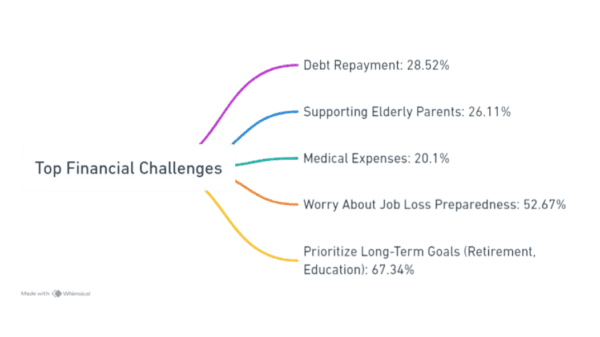
Financial security has become a common concern for many in a world where economic uncertainty is the norm. The latest survey from Finsafe India for FY 2023-2024 sheds light on the key financial challenges that corporate employees face today, emphasising the importance of careful planning and informed decisions.

1. Prioritising Long-Term Goals (67.34%)

The most significant financial challenge identified is the need to prioritise long-term goals, with 67.34% of respondents highlighting this as their primary concern. Long-term goals often include retirement planning, funding education, or purchasing a home. These goals require disciplined saving and investing, balancing immediate needs and future aspirations. A strategic approach, including diversified investments and regular financial reviews, can help in achieving these long-term objectives.

2. Worry About Job Loss Preparedness (52.67%)

The uncertainty surrounding job security is a major concern for 52.67% of people. Job loss preparedness is crucial in today’s volatile job market, where economic downturns, technological disruptions, and shifting market demands can lead to sudden unemployment. Building a robust emergency fund that can cover three to six months of living expenses is vital. Additionally, developing new skills and networking can enhance job security and preparedness.

3. Debt Repayment (28.52%)

Debt repayment is another pressing concern for 28.52% of respondents. Managing debt effectively is essential for maintaining financial health. High-interest debt, such as credit cards or personal loans, can quickly spiral out of control if not managed properly. Prioritising debt repayment by focusing on high-interest debts first and exploring debt consolidation options can help alleviate this financial burden. Creating a structured repayment plan and avoiding unnecessary borrowing are crucial steps in managing and reducing debt.

4. Supporting Elderly Parents (26.11%)

With 26.11% of individuals worried about supporting elderly parents, this issue highlights the growing financial responsibilities faced by the sandwich generation. This demographic is caught between supporting aging parents and raising their children. Rising healthcare costs and the need for long-term care can strain financial resources. To address this challenge, individuals should consider purchasing insurance for their parents, exploring government aid programs, and creating a family financial plan that includes provisions for elder care.

5. Medical Expenses (20.1%)

Finally, medical expenses are a concern for 20.1% of respondents. Unforeseen medical emergencies can lead to substantial financial strain, especially without adequate insurance coverage. Investing in a comprehensive health insurance plan and maintaining a separate medical emergency fund can provide a safety net against high medical costs. Additionally, engaging in a healthy lifestyle can help mitigate future medical expenses.

financial challenges in india

Conclusion

The top financial challenges identified—prioritising long-term goals, job loss preparedness, debt repayment, supporting elderly parents, and managing medical expenses—are interconnected and require a comprehensive approach to financial planning. By understanding these challenges and proactively planning for them, individuals can navigate their financial journeys more confidently and secure a more stable and prosperous future.

Remember, the key to overcoming these financial hurdles is consistent planning, disciplined saving, and making informed financial decisions. Whether it’s creating a budget, investing wisely, or seeking professional financial advice, taking the right steps today can lead to a more secure and stress-free tomorrow.

Please note,

The views in the article /blog are personal and that of the author. The idea is to create awareness and not intended to provide any product recommendations.

How Not to Plan Your Finances: Common Pitfalls to Avoid


How Not to Plan Your Finances: Common Pitfalls to Avoid

4 August 20243 min read
How Not to Plan Your Finances: Common Pitfalls to Avoid

Financial planning is a cornerstone of achieving long-term financial security and stability. However, not all financial planning is effective, and many people unknowingly make mistakes that can derail their financial goals. Knowing what not to do is just as important as knowing what to do. Here’s a look at some common financial planning mistakes and how to avoid them.

1. Living Without a Budget

One of the most significant financial mistakes people make is living without a budget. A budget is a fundamental tool that helps you understand your income, expenses, and savings. Without a budget, it’s easy to overspend on non-essentials and neglect savings and investments. The lack of a budget leads to financial chaos, making it difficult to track where your money is going. To avoid this, create an income and expense plan that outlines your monthly budget and stick to it. Review it regularly to ensure you’re on track with your financial goals.

2. Failing to Build an Emergency Fund

Another common mistake is failing to build an emergency fund. Life is unpredictable, and unexpected expenses can arise at any time, such as medical emergencies, car repairs, or job loss. Without an emergency fund, you may have to rely on credit cards or loans, leading to debt. An emergency fund acts as a financial safety net and should cover at least three to six months of living expenses. Start by setting aside a small amount each month until you reach your goal.

3. Neglecting to Plan for Retirement

Many people focus solely on short-term goals and neglect to plan for retirement. This is a significant mistake that can have long-term consequences. Relying solely on government pensions or employer-provided retirement plans may not be sufficient to maintain your lifestyle in retirement. Start saving for retirement as early as possible, taking advantage of retirement investments like NPS which offer tax benefits and corpus to rely on.

4. Ignoring Debt Repayment

Ignoring debt repayment is another financial planning mistake. High-interest debts, like credit card balances, can quickly accumulate and become overwhelming. Failing to prioritise debt repayment can lead to increased financial stress and limit your ability to save and invest for the future. Develop a debt repayment plan that focuses on paying off high-interest debts first while making minimum payments on others. Consider debt consolidation or refinancing options if necessary.

5. Making Emotional Investment Decisions

Investment decisions driven by emotions, such as fear or greed, can lead to significant financial losses. Many investors panic during market downturns and sell off assets at a loss, only to buy back at higher prices when the market recovers. This “buy high, sell low” approach is counterproductive and undermines long-term wealth building. Instead, maintain a disciplined approach to investing, focusing on a diversified portfolio that aligns with your risk tolerance and long-term financial goals.

6. Overlooking Insurance Needs

Insurance is often overlooked in financial planning. Many people either don’t have adequate coverage or are underinsured. Insurance is essential for protecting your assets and income in the event of unforeseen circumstances, such as accidents, illnesses, or natural disasters. Review your insurance policies regularly to ensure they provide adequate coverage for your needs.

7. Not Seeking Qualified Financial Advice

Lastly, many people make the mistake of not seeking professional financial advice. While DIY financial planning is possible, it may not always be the best approach, especially for complex financial situations. A qualified financial advisor can provide personalised advice, help you develop a comprehensive financial plan, and guide you through significant life events.

Conclusion

Avoiding these common financial planning mistakes can help you stay on track toward achieving your financial goals. Remember, successful financial planning is not just about what you do; it’s also about avoiding the pitfalls that can derail your progress. By creating a budget, building an emergency fund, planning for retirement, prioritising debt repayment, making rational investment decisions, ensuring adequate insurance coverage, and seeking professional advice when needed, you can build a solid financial foundation for the future.

Please note,

The views in the article /blog are personal and that of the author. The idea is to create awareness and not intended to provide any product recommendations.
Leveraging Derivatives for Personal Wealth Management – Pros and Cons


Leveraging Derivatives for Personal Wealth Management – Pros and Cons

By TETALA TEJA REDDY
30 March 20244 min read
Leveraging Derivatives for Personal Wealth Management – Pros and Cons

Leverage allows traders to amplify their exposure to an underlying asset without needing to commit the full value of the position. It enables traders to control a larger notional value of assets than their available capital would typically allow. Leverage is expressed as a ratio, such as 10:1, indicating that for every unit of trader’s capital, they can control ten units of that underlying asset.

In derivatives trading, leverage is often provided by the broker or exchange. It allows traders to enter larger positions with a smaller fraction of the total contract value as collateral, known as margin. Leverage enables traders to capitalize on even small price movements of underlying assets, potentially leading to substantial profits.

How Does Leverage Work?

Trading Without Leverage

You have INR 1,00,000 in your trading account, and you want to buy shares of ABC Corporation. The current share price is INR 100.00 per share. You buy 1,000 shares, so your investment is INR 1,00,000. If the share price goes up by 5%, you can sell out of your position for INR 105.00 per share:

Return: 1,000 shares x INR 105.00 = INR 1,05,000

Profit INR 5,000 (or 5%)

Trading With Leverage

When you use leverage, you can get exposure to many more shares than you could buy outright. For example, when you buy ABC Corporation shares using 20x leverage, you could get exposure to 20 times as many shares, i.e. 20,000 shares, but only commit 5% of the money (called margin deposit or initial margin):

Current share price: INR 100

Actual Cost (margin) INR 1,00,000

Exposure INR 20,00,000

If the share price goes up by 5%, you can sell out of your position for INR 105 per share:

Return: 20,000 shares x INR 105 = INR 21,00,000

Profit INR 1,00,000 (or 100% of your INR 1,00,000 investment)

Pros of Using Leverage

  • Increased Profit Potential

One of the main advantages of using leverage is the ability to generate higher profits. By borrowing funds to invest in assets, traders can magnify their gains. For example, if a trader invests INR 10,00,000 in stock and the stock rises by 10%, they would make a profit of INR 1,00,000. However, if the trader uses leverage to invest INR 1,00,00,000 in the same and the stock rises by 10%, they would profit INR 10,00,000.

  • Access to More Trading Opportunities

Another benefit of using leverage is the ability to access more trading opportunities. With limited capital, traders may be unable to invest in certain assets or markets. However, with leverage, traders can access a broader range of opportunities, potentially leading to higher profits.

  • Flexibility

Leverage also provides traders with more flexibility in their trading strategies. Traders can use leverage to take advantage of short-term market fluctuations or to hold positions for long periods of time. This flexibility can help traders adapt to changing market conditions and improve their overall trading performance.

Cons of Using Leverage

  • Increased Risk

A disadvantage of using leverage is the increased risk. When traders borrow funds to invest in assets, they essentially use debt to finance their investments. That means that if the investments do not perform as expected, the trader may lose their initial investment also, owing money to the lender.

  • Margin Calls

Margin calls are another risk associated with using leverage. When traders use leverage, they are required to maintain a certain level of equity in their accounts. If the value of their investments falls below this level, the broker may issue a margin call, requiring the trader to deposit additional funds to cover the losses. If the trader cannot meet the margin call, the broker may liquidate their position, resulting in significant losses.

  • Psychological Pressure

Using leverage can also create psychological pressure for traders. The potential for higher profits can lead to greed and overconfidence, causing traders to take on more risks than they can handle. That can lead to impulsive trading decisions and ultimately result in significant losses.

Conclusion

Leverage is a powerful tool in derivative contracts and trading that can possibly lead to substantial profits and gains. But it comes with inherent risks, which demand a disciplined and cautious approach. Investors should prioritize risk management practices, such as prudent position sizing, setting stop loss orders, diversification, and continuous monitoring. By understanding the benefits and drawbacks of leverage and implementing effective risk management strategies, traders can harness its potential while safeguarding their capital from excessive losses. As with any particular trading endeavour, education, preparation, and a comprehensive understanding of leverage are essential for successful and everlasting trading in derivative contracts and making sound and safe investment decisions.

Please note,

The views in the article /blog are personal and that of the author. The idea is to create awareness and not intended to provide any product recommendations.

How to Invest in ETF in India: A Comprehensive Guide


How to Invest in ETF in India: A Comprehensive Guide

4 December 20248 min read
How to Invest in ETF in India: A Comprehensive Guide

Exchange Traded Funds (ETFs) are quickly becoming one of the most popular investment choices in India, and for good reason. With their low costs, flexibility, and the simplicity of buying and selling them like stocks, it’s no wonder many investors are asking how to invest in ETF in India as a smarter alternative to traditional mutual funds.

In this blog, we’ll walk you through everything you need to know about how to invest in ETF in India, including the different types of ETFs available, and the important things you should consider before diving in.

What is meaning of ETF?

ETFs are investment funds that track an index, commodity (like gold or silver), or a basket of securities (such as stocks of an underlying index).  With over 225 ETFs available in the Indian market, these funds provide a cost-effective way to diversify your portfolio with a single purchase.

Key advantages of  investing in ETF in India include:

  • Low Costs: ETFs have lower expense ratios compared to mutual funds, making them an attractive choice for cost-conscious investors.
  • Diversification: Investing in an ETF allows you to gain exposure to a variety of assets like stocks, commodities, and indices, which helps in spreading risk.
  • Liquidity: ETFs are traded on stock exchanges like individual stocks, so you can buy or sell them at market prices during trading hours.

Fun Fact

Around 13% of the overall AUM of the Mutual Fund Industry is contributed by ETFs


Source:AMFI Annual Report

How to Invest in ETF in India: A Step-by-Step Guide

There are two main ways to invest in ETFs in India: through a Demat account or directly via a fund house.

1. Buying ETFs Through a Demat Account

To invest in ETF, you must first understand that ETFs are bought and sold in Demat form. Here’s a step-by-step guide on investing in ETFs using a Demat account:

Step 1: Open a Demat and Trading Account

  • The first step is to open a Demat and trading account with a registered brokerage firm.
  • Leading brokerage firms like Zerodha, Upstox, and ICICI Direct offer these services, making it easy for investors to start their ETF journey.

Step 2: Choose the ETF You Want to Invest In

Once your Demat and trading accounts are set up, you can begin exploring different types of ETFs available in India. The Indian market offers several categories of ETFs, such as:

  • Index ETFs: Track major indices like Nifty 50 or Sensex.
  • Commodity ETFs: Invest in commodities like gold, silver, or oil.
  • Thematic ETFs: These ETFs focus on specific sectors or themes (like technology or infrastructure).
  • Factor ETFs: These track factors such as value, momentum, or growth.

Step 3: Add ETFs to Your Watchlist

  • A key part is monitoring the price movements of your chosen ETFs. Most trading platforms allow you to add ETFs to a watchlist, helping you track their performance before making any decisions.

Step 4: Place Your Order

After selecting the ETF, you can place your order. Here’s how you can do that:

  • Market Order: Buy or sell the ETF at the current market price.
  • Limit Order: You can specify a price at which you want to buy or sell. The order will only execute when the price reaches your target level.

Once the order is executed, the ETF will reflect in your Demat account and be part of your portfolio.

2. Buying ETFs Through a Fund House

Here’s how to invest in ETF in India through fund house:

Step 1: Select a Fund House

  • There are several well-known fund houses offering ETFs in India, such as Nippon India, HDFC, and ICICI Prudential.
  • Research the available ETFs and find out which fund house offers the one you want to invest in.
  • This method involves buying units directly from the fund.

Step 2: Check the Minimum Investment Requirement

  • Fund houses typically require a lot size for certain ETFs, which might be higher than investing through a Demat account.
  • For example, a gold ETF may require a minimum investment of ₹50,000 or more.
  • Always check the minimum investment size before proceeding.

Step 3: Invest in the ETF

  • Once you’ve selected an ETF from the fund house, you can make the investment by purchasing the ETF units directly.
  • This method is often used for buying commodity-based ETFs like gold ETFs.

Factors to Consider Before Choosing a Broker

The broker you choose plays a crucial role in the investment process. Here are some factors to consider:

  • Fees: Look for brokers that offer low trading charges or zero commissions on certain ETFs. This will help you reduce the overall cost of investing.
  • User-Friendly Platform: Ensure the platform is intuitive and provides all the necessary tools to monitor and execute your trades efficiently.
  • SIP Facility: Check if the broker offers a Systematic Investment Plan (SIP) facility for ETFs. SIPs allow investors to invest a fixed amount regularly and benefit from rupee cost averaging.

Factors to Consider Before Choosing an ETF

It’s important to select the right ETF based on your goals. Here are some factors to consider:

  • Expense Ratio: This annual fee is charged as a percentage of your total investment. A lower expense ratio means more of your investment is working for you over the long term.
  • Tracking Error: This measures how closely an ETF tracks its benchmark index. Low tracking error is ideal for investors who want their ETF to closely reflect the performance of the underlying index.
  • Liquidity: Higher liquidity means that the ETF is traded more frequently, making it easier to buy and sell at market prices without large price fluctuations.

Benefits of Investing in ETFs

  1. Diversification: Investing in ETF gives you access to a diversified portfolio, helping you spread your risk across different asset classes.
  2. Lower Costs: ETFs usually have lower fees compared to mutual funds, making them a cost-effective choice for long-term investors.
  3. Flexibility: ETFs can be traded throughout the day like stocks, giving you the flexibility to buy or sell when you wish.
  4. Transparency: ETFs disclose their holdings regularly, allowing investors to know exactly what they are investing in.

Conclusion

Investing in ETFs in India is a great way to diversify your portfolio with a low-cost, flexible investment option. Whether you choose to invest through a Demat account or directly with a fund house, how to invest in ETF in India is an easy and effective process. Always consider factors like expense ratio, tracking error, and liquidity when choosing the right ETF for your investment goals.

Start your ETF journey today and watch your investments grow with ease!

FAQs:

How to invest in ETF in India through SIP?

Many brokers and fund houses offer the SIP facility for ETFs, allowing you to invest small amounts regularly.

What is the minimum investment required to buy ETFs?

The minimum investment amount can vary depending on the broker or fund house. With a Demat account, you can buy one unit of an ETF, while fund houses may have a higher lot size.

Are ETFs a safe investments?

ETFs are generally safe as they offer diversification, but like all investments, they carry risks. Always assess your risk appetite before investing.

By following this guide, you now know exactly how to invest in ETF in India and how to make informed decisions about your investment. Happy investing!

Please note,

The views in the article /blog are personal and that of the author. The idea is to create awareness and not intended to provide any product recommendation

Documents Required for Surrendering a Life Insurance Policy


Documents Required for Surrendering a Life Insurance Policy

1 July 20243 min read
Documents Required for Surrendering a Life Insurance Policy

Surrendering a life insurance policy with the Life Insurance Corporation (LIC) of India involves a structured process where the policyholder needs to submit specific documents to the insurance company. These documents are essential to verify the policyholder’s identity, ensure the validity of the surrender request, and facilitate the transfer of the surrender value. Additionally, using the LIC Surrender Value Calculator can help policyholders estimate the surrender value of their policy before proceeding with the surrender. Here’s a comprehensive guide to the documents required and how to use the LIC Surrender Value Calculator.

The Surrender Discharge Form

The primary document needed for surrendering a life insurance policy is the Surrender Discharge Form, also known as Form 5074. This official document is provided by the insurance company and must be filled out and signed by the policyholder. The form indicates the policyholder’s intent to surrender the policy and initiates the surrender process.

NEFT Mandate Form

To ensure the seamless transfer of the surrender value directly to the policyholder’s bank account, an NEFT (National Electronic Funds Transfer) Mandate Form is required. This form authorizes the insurance company to deposit the surrender value into the policyholder’s designated bank account. It is crucial to fill out this form accurately to prevent any issues during the funds transfer.

Identification Documents

Identification documents are necessary for verifying the policyholder’s identity. Typically, a copy of the policyholder’s PAN Card and Aadhaar Card (or other officially recognized identification documents) must be submitted. These documents help confirm that the person requesting the surrender is indeed the policyholder.

Original Policy Document

The original life insurance policy document is a critical requirement for surrendering the policy. This document serves as proof of the insurance contract that is being surrendered. The policyholder must ensure that they submit the original document to avoid any delays in processing the surrender request.

Cancelled Cheque

A cancelled cheque from the policyholder’s bank account is required to provide the insurance company with accurate bank account details. This helps ensure that the surrender value is credited to the correct account. The cheque should be from the same account mentioned in the NEFT Mandate Form.

Postal Stamp of ₹1

A nominal postal stamp of ₹1 is required as part of the documentation process. This small formality ensures that all necessary legal requirements are fulfilled.

Reasons for Surrendering the Policy

While not always mandatory, some insurance companies may request a written statement explaining the reason for surrendering the policy. This information can help the insurance company understand the policyholder’s motivation and is useful for their records. It may also aid in addressing any concerns the policyholder might have had about their policy.

Submission to the Relevant Branch

To streamline the surrender process, it is important to submit all the required documents to the branch where the policy was originally issued. This ensures that the surrender request is handled by the correct office and processed efficiently. The original LIC policy document will typically indicate the relevant branch for submission.

Using the LIC Surrender Value Calculator

Before surrendering a life insurance policy, it is beneficial to use the LIC Surrender Value Calculator to estimate the surrender value of the policy. This tool helps policyholders understand the financial implications of surrendering their policy. Here’s how to use the LIC Surrender Value Calculator:

Visit the LIC Website: Go to the official LIC website and navigate to the Surrender Value Calculator section.

Enter Policy Details: Input the necessary details, such as the policy number, sum assured, policy term, and the number of premiums paid.

Calculate Surrender Value: The calculator will process the entered information and provide an estimated surrender value based on the policy’s terms and conditions.

Conclusion

Surrendering a life insurance policy with LIC requires a detailed and systematic process. The required documents collectively enable the insurance company to process the surrender request while ensuring compliance with regulatory requirements and safeguarding against fraudulent activities. Additionally, using the LIC Surrender Value Calculator can help policyholders make an informed decision by providing an estimate of the surrender value. By following these guidelines and submitting the necessary documents, policyholders can facilitate a smooth and efficient surrender of their life insurance policy

Please note,

The views in the article /blog are personal and that of the author. The idea is to create awareness and not intended to provide any product recommendations.

Why Financial Planning Is More Important Than Ever in 2025

  Why Financial Planning Is More Important Than Ever in 2025 3 January 2025 3 min read The financial world in 2025 is more dynamic and unpre...